Burton’s Airstream trailer
The PeripheralBurton’s Airstream trailer is a battered 1977 vehicle converted into his home beside the creek, a place where Fisher family memories, the material traces of military service, and Flynne’s work in a remote London converge. It is at once shelter, improvised personal territory, and the physical frame for experiences that become increasingly difficult for Flynne to dismiss as a game.
A Family Refuge Reclaimed
The trailer had belonged to an uncle, a veteran of another war and the older brother of Flynne and Burton’s father. When Flynne, Burton, and Leon were children, they used it as a fort for a summer; later, Leon tried to bring girls there, but the smell put them off. By the time Burton was discharged, it stood empty except for the largest wasp nest the siblings had ever seen. Leon recognized its value as a 1977 Airstream, a model sought after by collectors and capable of fetching a high price even in poor condition. That potential sits oddly beside its neglected appearance: their uncle had covered it in white expanding foam to stop leaks and insulate it, leaving a gray, dirty shell Flynne thinks resembles a huge grub, its tunnels leading back to the windows.
The vehicle’s transformation from inherited ruin into Burton’s home is practical rather than polished. Its appearance carries the accumulated marks of use and abandonment, while its value as a collectible remains an idea Leon can point to on eBay. To Flynne, it is instead a familiar childhood fort made habitable again—an old family space whose earlier associations persist even as Burton makes it his own.
Burton’s Home and the Marks of Service
The trailer offers little separation between domestic life and the consequences of Burton’s military service. Flynne sees the marks where his haptics were removed, silvered patches along his spine and side, including one above his navel that his new white T-shirt covers. The haptics sometimes glitch him with a shiver; the family has been told it is not PTSD, but that he experiences something like phantom limb: ghosts of wartime tattoos that once signaled when to run, hold still, or move, and in which direction and at what range. He receives some disability recognition for this, but does not want to keep returning for further treatment, even though he has been told the marks could also be removed.
That history is not abstract in the trailer. Flynne glimpses Burton through a window before calling to him; he answers with her gamer tag, Easy Ice, and pulls his shirt down over the exposed patch. The small movement links a familiar brotherly exchange to the bodily evidence of a system no longer present but still capable of making itself felt. The trailer shelters him without erasing those traces, and its close quarters make them part of the everyday scene rather than distant military history.
A Carefully Maintained Improvisation
Inside, the Airstream is lit by LEDs buried in a yellow, amber-toned interior. Burton had not brought a shop vacuum down from the garage before moving in; instead, he coated the floor with roughly an inch of Chinese polymer that dried into a flexible, glassy layer. Bits of burnt matches and the cork-patterned paper from an old cigarette filter remain visible beneath it, along with other small remnants of previous occupants. Flynne remembers where a rusty jeweler’s screwdriver lies and where to find a 2009 quarter. The transparent coating preserves dirt and debris even as it contains them, turning cleaning into a form of collection.
Burton’s routine is to remove his belongings and hose the interior out every week or two, much as one might wash a plastic container. Leon calls the polymer curatorial: it can be peeled away with the dirt before the Airstream is eventually put up for sale. That future resale value coexists with Burton’s present habitation, giving the trailer two lives at once: a lived-in refuge and a vehicle kept, however roughly, in recoverable condition.
Its comforts are equally makeshift. The trailer can become intensely hot after standing closed all day; Leon wants to install air conditioning, but Burton is not interested, and he is usually away during daylight. The windows open along tunnels through the foam exterior, one of which a gold-and-black spider has begun to web across. Inside, a Chinese chair attempts to adjust itself to Flynne before she sits and finds it fits. These details place new technologies and small intrusions of living nature amid the old vehicle’s improvised repairs, without making the trailer feel like a conventional, finished home.
The Trailer as Workplace and Threshold
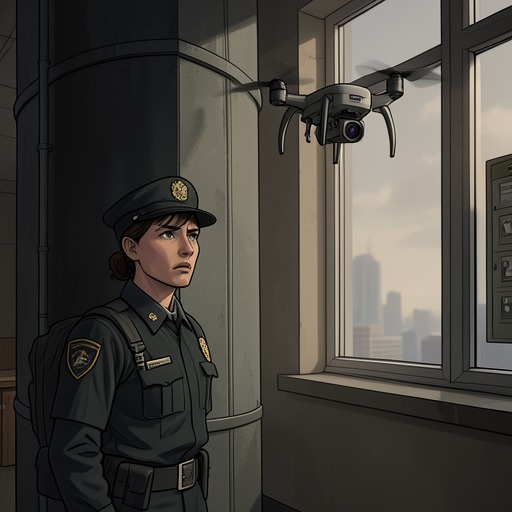
The trailer is also where Burton’s security work becomes Flynne’s responsibility. He asks her to take a five-hour shift flying a quadcopter, as though nothing has happened when she notices the telltale haptics shiver. She objects that he is on disability and should not be working, but the practical need for someone to cover the shift draws her into the job. Later, after preparing herself, she returns to the trailer intending to be sharp for the work and curious about London. Her care in getting dressed comes from habits learned from Burton and the Corps: being ready for an undertaking means first getting herself squared away. She does not particularly enjoy gaming, but she has made money from it before, and she wants to see more of the city and learn about the woman whose life she is observing.
At the trailer, she opens the windows, puts a sandwich in the refrigerator, straightens the interior, and settles into Burton’s chair. The familiar domestic actions form the threshold to the remote experience: she checks her phone and searches about London, then returns to the display. The same space that holds traces of childhood and the aftereffects of war is also a work station from which Flynne looks into another life. That contrast keeps the virtual city connected to the ordinary conditions of the person watching it: heat, a sandwich, a spider’s web, and a chair finding its fit.
A Frame for Grief
The trailer’s most consequential return is not a piece of equipment but a moment of recognition and loss. Suspended in the gyros, Flynne watches a gray object breathe. Its appearance changes: it becomes bronze-black and geometrically straight, while the surrounding face of a high-rise is misted with condensation. She later sees a falling figure diminish as it passes the floors, until the body has become two fluttering pieces of clothing. Flynne remembers the voices, stops before the twentieth floor, and hangs in the slack of the gyros, overcome by sorrow and disgust.
The narrative places her response back in the trailer’s hot darkness. With tears on her cheeks, she says, “Just a game.” The words attempt to restore a boundary between the safe, physical interior and the violence on the display, but the scene has already shown how little that boundary can contain. When she resumes the ascent, she feels blank and miserable and no longer tries to take in the city. At the fifty-sixth floor the window has disappeared and the balcony has folded back over it; the bugs remain, their transparent bubbles facing the place where the window had been. In this ending, the trailer is less an escape from what Flynne has seen than the place where she must experience its emotional consequence. Childhood shelter, Burton’s improvised home, and the workstation from which London becomes visible meet in one enclosed space, where the phrase “Just a game” registers both the distinction Flynne needs and the grief that defeats it.